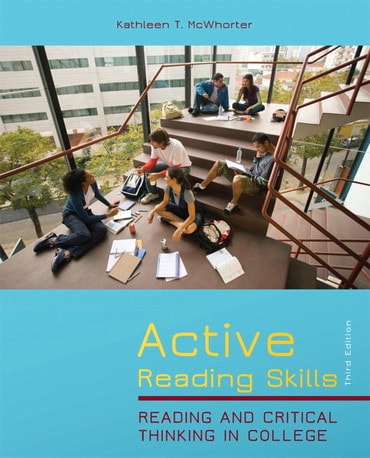
Description
Active Reading Skills focuses on essential skill areas for college-reading success, and improves students' reading through concise instruction, and extensive practice and testing. Each chapter focuses on a specific reading and thinking skill, and contains exercises that get students applying the learned skill to textbooks and ends with a vocabulary enrichment exercise.
Table of Contents
PART ONE: COLLEGE READING SKILLS
Chapter 1: READING COLLEGE TEXTBOOKS: AN ACTIVE APPROACH
Keys to Academic Success
Control External Distractions
Increase Your Attention Span
Read and Learn Actively
Preview Before Reading
How to Preview
Demonstration of Previewing
Making Predictions
Use Guide Questions
Textbook Reading Skills
Textbook Learning Aids
The SQ3R Reading/Study Method
Learning/Recall Strategies
An Introduction to Critical Thinking
The Textbook Challenge: Reading in Communication/Speech Disciplines: Kinesics
Chapter Summary Self-Test
Practice Test 1
Practice Test 2
Mastery Test 1
Mastery Test 2
Mastery Test 3: Diversity in U.S. Families (Textbook Excerpt)
Chapter 2: STRENGTHENING YOUR VOCABULARY
What is Context?
Types of Context Clues
Definition Clues
Synonym Clues
Example Clues
Contrast Clues
Inference Clues
What Are Word Parts?
Prefixes
Roots
Suffixes
Thinking Critically About Vocabulary
Textbook Challenge: Reading in Science Disciplines: What Causes Extinction?
Chapter Summary Self-Test
Practice Test 1
Practice Test 2
Mastery Test 1
Mastery Test 2
Mastery Test 3: Greenwashing
Chapter 3: IDENTIFYING AND ANALYZING MAIN IDEAS
Why Are Main Ideas Important?
Distinguishing Between General and Specific Ideas
Locating the Topic
Locating the Main Idea
Tips for Finding the Main Idea
Tips for Locating the Topic Sentence
Locating the Central Thought
Thinking Critically About Main Ideas
Textbook Challenge: Reading in Business Disciplines: Guerrilla Marketing
Chapter Summary Self-Test
Practice Test 1
Practice Test 2
Mastery Test 1
Mastery Test 2
Mastery Test 3: Stop Asking Me My Major
Chapter 4: EXAMINING DETAILS AND TRANSITIONS
Why Are Supporting Details Important?
UsingTransitions
Thinking Critically About: Details
Textbook Challenge: Reading in Career Fields: Fear of Crime
Chapter Summary Self-Test
Practice Test 1
Practice Test 2
Mastery Test 1
Mastery Test 2
Mastery Test 3: Talking A Stranger Through the Night
Chapter 5: WORKING WITH IMPLIED MAIN IDEAS
What Does Implied Mean?
Distinguishing Between General and Specific Ideas
Identifying Implied Main Ideas in Paragraphs
Finding Implied Main Ideas in Visuals
Thinking Critically About: Details
Textbook Challenge: Reading in the Social Sciences: Who Should Live and Who Should Die? The Dilemma of Rationing Medical Care
Chapter Summary Self-Test
Practice Test 1
Practice Test 2
Mastery Test 1
Mastery Test 2
Mastery Test 3: Friendship for Guys (No Tears!)
Chapter 6: ORGANIZING INFORMATION
Why Keep Track of Information?
Highlighting and Marking
Highlighting Effectively
Marking to Record Ideas
Outlining
Mapping
Summarizing
Good Reasons to Keep Track Of Information
Thinking Critically About: Keeping Track of Information
Textbook Challenge: Reading in Health Fields: Gender Differences and Health
Chapter Summary Self-Test
Practice Test 1
Practice Test 2
Mastery Test 1
Mastery Test 2
Mastery Test 3: Employee Speech in the Digital Age
Chapter 7: EXAMINING BASIC PATTERNS OR ORGANIZATION
What Are Patterns of Organization?
Example
Definition
Combining Definition and Example
Chronological Order and Process
Listing
Combining Patterns of OrganizationThinking Critically About the Example Pattern
Textbook Challenge: Reading Literature: What is Fiction? (includes a short short , "A Gentleman's C" by Padgett Powell)
Chapter Summary Self-Test
Practice Test 1
Practice Test 2
Mastery Test 1
Mastery Test 2
Mastery Test 3: Animals at Play (Textbook Excerpt)
Chapter 8: EXAMINING COMPARISON/CONTRAST AND CAUSE/EFFECT PATTERNS
Comparison/Contrast Patterns
ComparisonContrast
Using Both Comparison and Contrast
Cause and Effect Patterns
Other Useful Patterns
Classification
Statement and Clarification
Summary
Addition
Spatial Order
Thinking Critically About Comparison/Contrast and Cause/Effect
Textbook Challenge: Reading History: Whether to Vote: A Citizen's First Choice
Chapter Summary Self-Test
Practice Test 1
Practice Test 2
Mastery Test 1
Mastery Test 2
Mastery Test 3: Global Warming
PART TWO: CRITICAL READING SKILLS
Chapter 9: MAKING INFERENCES AND ANALYZING THE AUTHOR’S PURPOSE
What Is Inference?
How to Make Inferences
Making Inferences about Graphics
Understanding Author’s Purpose
Considering Style and Intended Audience
Analyzing Language: Denotation and Connotation
Critical Thinking Challenge: Reading Blogs: Green Exercise Better Than Just Plain Exercise
Chapter Summary Self-Test
Practice Test 1
Practice Test 2
Mastery Test 1
Mastery Test 2
Mastery Test 3: Boots on the Ground: A Day in the Life of a Border Sheriff
Chapter 10: DISTINGUISHING FACT FROM OPINION
Is It Fact or Opinion?Fact
Opinion
Judgment Words
Mixing Fact and Opinion
Evaluating Fact and Opinion
Recognizing Informed Opinion
The Critical Thinking Challenge: Reading Newspapers: College Apologizes After Instructor Says Spanish Can't Be Spoken in Class
Chapter Summary Self-Test
Practice Test 1
Practice Test 2
Mastery Test 1
Mastery Test 2
Mastery Test 3: Therapy Dogs
Chapter 11: ANALYZING TONE AND BIAS
RecognizingTone
Tone and Connotative Meanings
Identifying Tone
Tone: The Relationship Between the Writer and Reader
Understanding Irony and Sarcasm
Analyzing Bias
What is Bias?
How to Detect Bias
The Critical Thinking Challenge: Reading Magazine Articles: Fear Itself
Chapter Summary Self-Test
Practice Test 1
Practice Test 2
Mastery Test 1
Mastery Test 2
Mastery Test 3: Love on the Internet and Video Dating (Textbook Excerpt)
Chapter 12: READING ARGUMENTS
What is an Argument?
Parts of an Argument
The Issue
The Claim
The Support
Questions for EvaluatingArguments
Is the Evidence Relevant?
Is the Evidence Sufficient?
Does the Author Use Emotional Appeals and Are They Used Unfairly?
Errors in Logical Reasoning
Circular Reasoning
Hasty Generalization
Non Sequitur
False Cause
Either-Or Fallacy
Arguments in Academic Writing
The Critical Thinking Challenge: Reading Editorials: Our View on Your Health: What Can Be Done to Shake America's Salt Habit?
Chapter Summary Self-Test
Practice Test 1
Practice Test 2
Mastery Test 1
Mastery Test 2
Mastery Test 3: Don’t Panic
PART THREE: STUDENT RESOURCE GUIDE
Appendix A: Exit Exams and Comptency Tests
Appendix B: Evaluating Internet Sources
This title is also sold in the various packages listed below. Before purchasing one of these packages, speak with your professor about which one will help you be successful in your course.
Package ISBN-13: 9780321911537
Includes this title packaged with:
- NEW MyReadingLab -- Valuepack Access Card
Pearson - Oxford New Desk Dictionary and Thesaurus
Oxford University Press
$108.33 | Add to Cart
Purchase Info
ISBN-10: 0-205-02843-8
ISBN-13: 978-0-205-02843-6
Format: Paper
$101.67 | Free Ground Shipping.
Digital Choices
MyLab & Mastering 
MyLab and Mastering products deliver customizable content and highly personalized study paths, responsive learning tools, and real-time evaluation and diagnostics. MyLab and Mastering products help move students toward the moment that matters most—the moment of true understanding and learning.
Buy AccessMyReadingLab with Pearson eText -- Instant Access -- for Active Reading Skills, 3rd Edition
$74.80 | ISBN-13: 978-0-205-09929-0
eTextbook 
With CourseSmart eTextbooks and eResources, you save up to 60% off the price of new print textbooks, and can switch between studying online or offline to suit your needs.
Once you have purchased your eTextbooks and added them to your CourseSmart bookshelf, you can access them anytime, anywhere.
Active Reading Skills: Reading and Critical Thinking in College, CourseSmart eTextbook, 3rd Edition
$40.99 | ISBN-13: 978-0-205-02776-7
Print Choices
Loose Leaf Version 
Books a la Carte are less-expensive, loose-leaf versions of the same textbook.
$66.67 | ISBN-13: 978-0-205-10937-1